
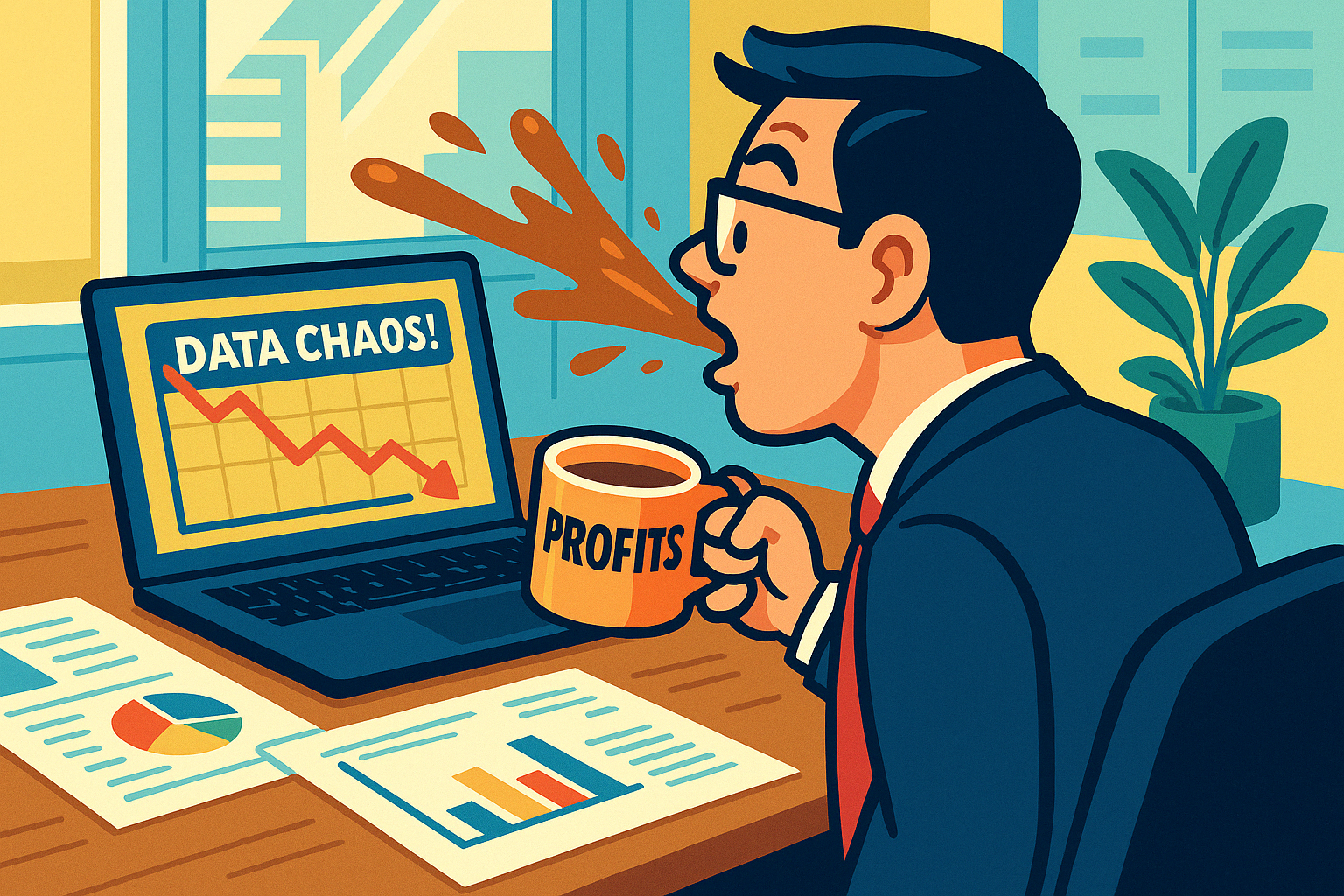
Imagine being a skilled CFO, just taking the first sip of your latte, when the quarterly financial report lands on your desk. Profits are down again. You’ve slashed costs, streamlined operations, and haggled with suppliers so much they’ve started avoiding your calls. Yet, the numbers still don’t add up. What if the real culprit isn’t your strategy, your team, or the market, but something far sneakier? Say hello to bad data, the silent profit killer lurking in your spreadsheets.
Bad data is the incorrect, incomplete, or outdated information that slinks into your systems like a crafty leech, quietly draining your profits while you’re busy looking the other way. It’s not loud or obvious. No alarms go off when your customer database lists “Mickey Mouse” as a VIP client or when a decimal point goes astray in your invoices. But the damage? Oh, it’s very real.
Real-World Stories
In a research article updated in 2023 by Monte Carlo Data, over half of the respondents believe data quality issues have a significant negative impact on their company’s revenue, equivalent to at least 25% of the total turnover. Put another way: for every £1 million your company earns, £250,000 could slip through the cracks due to bad data. And that’s just the tip of the iceberg. Missed opportunities and weakened competitiveness from poor data quality create problems that quietly erode your bottom line.
The evidence is plentiful. Take the credit bureau Equifax, as detailed in a 2025 article by Invensis.Back in 2022, they sent inaccurate credit scores to over 300,000 people, with errors deviating by more than 25 points from the correct figures. The result? A 5% drop in share price that cost millions quicker than you can say “whoops.”
A 2023 article by Datafold dishes up more chilling yet crucial examples. Samsung’s “fat-finger” blunder in 2018, where a typo led to an erroneous dividend payout, cost them millions. Then there’s Uber, who overpaid drivers by a staggering $45 million due to data quality issues in their accounting.
Despite these cautionary tales, Gartner reports that only four out of ten companies measure the financial cost of bad data. It’s a bit like ignoring a leaking pipe while your water bill soars.
The Underlying Poison of Bad Data
Bad data doesn’t just mess up your bottom line. Bad data is a pure waste of time and resources. People spend countless hours fixing errors, reconciling mismatched figures, and making sense of confusing data. It drags down efficiency, hikes up operational costs, and leaves your company quietly crippled by mediocrity, as if it’s been infected with a virus. But the fallout doesn’t end there. Bad data can also land your business in hot water with laws and regulations. In the worst cases, flawed or incorrect data (often unknowingly) can lead to actions that skirt the edge of legality or plunge straight into criminal territory. Think inaccurate reporting to authorities, misuse of personal data, or breaches of trade agreements based on faulty info. The cost of bad data can therefore exceed a dip in profits; it can threaten your company’s very existence and drag management into serious legal trouble.
Research backs this up, showing bad data poisons a company beyond just finances. A 2023 article by Y. Timmerman and colleagues in Decision Support Systems (find it here) builds on Gartner’s earlier findings about hefty losses from poor data quality. They break down the costs into direct hits (like Equifax’s share price tumble) and indirect ones (like your team’s endless battle to fix mistakes), concluding that bad data’s impact is multifaceted. The expenses for prevention, detection, and correction pile up fast if you’re not vigilant and proactive.
Three Methods to Overcome the Data Problem
So, how do you halt this profit-guzzling plague? Here are three concrete steps to tame your data:
- Conduct regular audits of your data sources
Treat your data with the same care as your finances: schedule regular check-ups. Cross-check sources, verify entries, and weed out anything outdated. It’s like checking expiry dates in your fridge—you wouldn’t use three-year-old yoghurt, so don’t let your business run on stale customer lists. A thorough audit can spot errors before they cost you millions. - Invest in tools to boost data quality
Picture these tools as the healthcare team for your data, running regular check-ups to keep it in tip-top shape. Data profiling tools can spot anomalies, cleansing and enrichment tools can fix errors and enhance records, and validation and monitoring tools ensure quality holds steady over time. Yes, there’s an upfront cost, but it’s peanuts compared to the 25% of revenue bad data could jeopardise. - Get your team to own the data
Your colleagues are the frontline defence against bad data. Show them why data quality matters and arm them with the best ways to tackle it. Automate manual entry to cut risks, standardise formats, and make accuracy a team effort. Pull it off, and you and your crew can become a brilliant vaccine against bad data.
Stop the Losses, Start Reaping the Rewards
Bad data is more than a nuisance - it’s a stealthy assassin of your earnings, working in the shadows. So, it’s time to saddle up and fight back! Picture yourself as that skilled CFO again, eyeing the quarterly reports. After a deep data review, the right tools, and a well-trained team, the outlook is transformed. The leaks are plugged, inefficiency is slashed, and the bottom line finally reflects the hard work you’ve put in. So, dive into your data, equip yourself with the right tools, and train your team. Do that, and you won’t just stop the losses, you’ll also sharpen your edge in a world where good data is worth its weight in gold. Now, that next sip of latte can be savoured with peace of mind, knowing the silent killer is under control.
Sources:
– Monte Carlo: The Annual State of Data Quality Survey
– Invensis: Major Costs of Poor Data Quality: How to Avoid Them
– Datafold: Enterprises Whose Bad Data Cost Them Millions: Lessons from Samsung and Uber
– Gartner: How to Stop Data Quality Undermining Your Business
– Timmerman et al.: Cost-based analysis of the impact of data completeness and representational consistency


Leave a Reply